Quick Answer: Start with a protein target that fits your needs. Plan foods you enjoy across your usual meals, then check the daily totals for calories, carbs, and fat. If the plan is hard to fit into your day, adjust the meals or portions before using it again.
You might have a protein goal and still reach dinner unsure how to meet it. Or you might reach it and notice that your meals contain more calories, or fewer carbs, than you planned.
Planning a few meals ahead can help you see this earlier. Here’s how to build a day that fits your protein goal and the way you normally eat.
How protein fits with your other macros
A meal plan can meet your protein target without fitting the rest of your nutrition plan. For example, changing the type or portion of a protein-rich food can also change the meal’s calories, carbs, or fat.
That’s why it helps to check the totals for the full day. You can see whether the meals provide the protein you planned while still leaving room for the carbohydrate and fat sources you want to include.
Step 1: Choose a protein target and check the setting
Protein needs differ based on factors such as body size, age, health, activity, and training goals. You might choose a target using general guidance expressed in grams per kilogram of body weight, a plan developed with a dietitian, or a percentage of your daily calories.
If you’re still choosing a protein target, the Performance series article on protein, energy, and glycogen explains the starting points in more detail.
For the example later in this article, we’ll use 1.6 grams per kilogram of body weight per day. A meta-analysis found that protein intakes above roughly this amount were not associated with further average gains in fat-free mass during prolonged resistance training. The estimate came from studies of healthy adults who trained at least twice per week, so it is a reference point for this example, not a target everyone needs. [2]
Cronometer gives you three ways to set macro targets:
- Fixed Targets: Enter set amounts of protein, carbs, and fat. These targets remain the same each day.
- Macro Ratios: Choose the proportion of calories that comes from each macro. The gram targets change when the Energy Target changes.
- Keto Calculator: Set carbohydrate and protein limits, with the remainder of the calorie allowance assigned to fat. [3]
For the meal-planning example in this article, Fixed Targets or Macro Ratios can both be used. If you choose Fixed Targets, the calories calculated from those macro amounts may not exactly match the separate Energy Target shown in Cronometer. [4]
See Cronometer’s guides to Macro & Energy Targets for setup instructions.

Step 2: Start with the meals you usually eat
Start with the meals and snacks you normally eat. Add the foods and portions you expect to have, including protein sources where they fit naturally. Eggs, fish, tofu, beans, lentils, and dairy are some options, with the amount of protein depending on the food and portion.
Then check how the protein is distributed. If most of it is planned for dinner, would adding some at breakfast or lunch make the target easier to reach?
Your daily protein total is important. Spreading protein across meals may also provide more opportunities to support muscle protein synthesis, the process of building muscle proteins. The meals do not need to contain exactly the same amount. [5]
Here are two ways to plan the same 128 g daily total. Neither is automatically better. The first leaves more protein for dinner, while the second spreads more of it across breakfast and lunch. Comparing the two can help you see which pattern is easier to follow in your routine. These are hypothetical planning numbers, not measured meals or a recommendation for you
| Meal | First plan | Another option |
| Breakfast | 15 g | 35 g |
| Lunch | 30 g | 35 g |
| Afternoon snack | 25 g | 25 g |
| Dinner | 58 g | 33 g |
| Daily total | 128 g | 128 g |
Both plans total 128 g. The first may suit someone who prefers a larger dinner. However, if dinner changes, more of the planned protein changes with it. The second depends less on one meal and may suit someone who prefers to spread food more evenly through the day. The useful question is not which plan is universally better, but which one is more practical for the person following it.
Step 3: Check calories, carbs, and fat too.
Once the meals are entered, compare the daily totals with the targets you chose.
- If calories are higher than planned, check the portions and the other nutrients provided by the protein-rich foods. Some options also contribute substantial amounts of fat or carbs.
- If carbs are lower than planned, check whether the meals include the carbohydrate sources you intended to eat, particularly around activities for which you prefer more carbohydrate.
- If protein is lower than your target, look for a meal or snack where a different food or portion would fit.
- If the day requires too much time or costs more than you can manage, try repeating a simple meal, using fewer ingredients, or changing one of the more demanding recipes.
Cronometer calculates the totals from the foods and portions you enter, so review the entries if a result looks different from what you expected.
Step 4: Save meals you want to use again
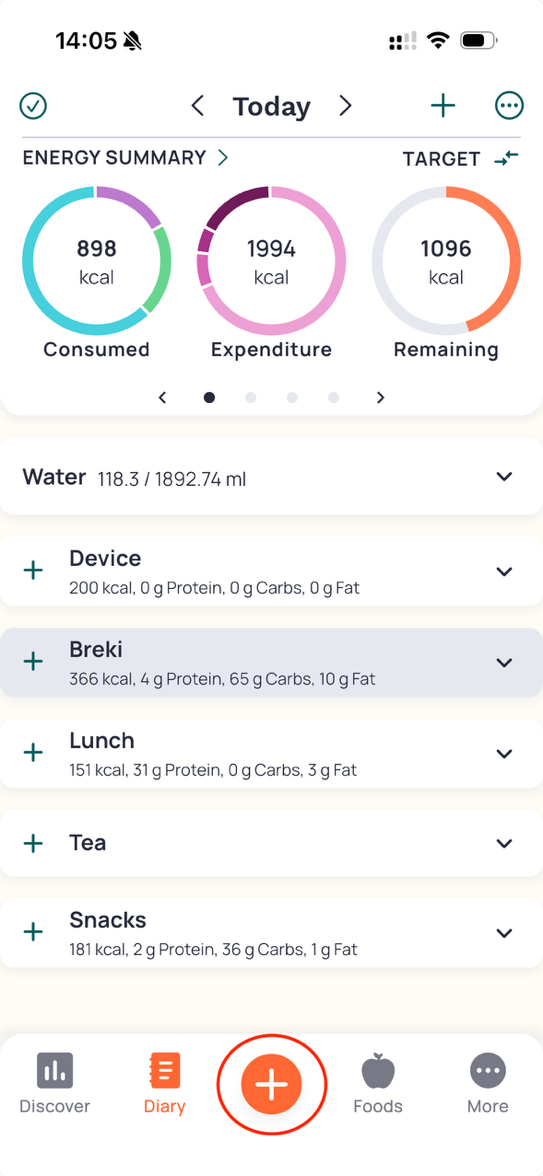
Diary Groups organize foods into meals such as breakfast and lunch. On mobile, swipe right on a group header and choose Show Nutrition Summary to review the nutrients in that group. [6]
If you want to log those foods together again:
- Swipe right on the Diary Group header.
- Choose Create Meal from Group.
- Review the foods and portions in the meal editor, then save the meal. [6]
You can find the saved Custom Meal when adding food to your diary. Check the portions when logging it again if the amount you ate changed. [7]
See the Diary Groups and Custom Meals guides for more tips.
Adjust the plan to fit your day
Some meals will change. You may be hungrier than expected, eat out, or have less time to cook. You can update the portions or foods and see what changed.
If the same part of the plan is difficult each day, that’s a useful place to make an adjustment. Your preferences, appetite, and budget belong in the plan too.
Frequently Asked Questions
How do I make a high-protein meal plan that fits my macros?
Start with your chosen targets. Enter the meals and portions you expect to eat, then review protein alongside calories, carbs, and fat. Adjust the parts that don’t fit your plan.
Should I use a fixed protein target or a macro ratio?
A fixed target suits a plan with a set protein amount in grams. A macro ratio suits a plan based on proportions of calories. With ratios, the gram targets change when the calorie target changes. [3]
Does every meal need the same amount of protein?
No. Your daily total matters, and spreading protein across meals may be useful, but the amounts do not need to match exactly. One person may prefer more protein at dinner, while another may find the target easier to reach by including more at breakfast and lunch. [5]
Can Cronometer create a high-protein meal plan?
You can use Cronometer to plan your own meals against nutrition targets and save foods you often eat together. In the approach described here, you choose the foods and portions; the app calculates the nutrition totals. [3,7]
Try planning tomorrow’s meals
If you’d like to try this, enter tomorrow’s meals in Cronometer and review the totals. Start with one change that would make the day easier to follow.
For help reviewing your current intake, read the Performance series article on checking protein, calories, and carbs when training progress has slowed.
Sources
1. Thomas DT, Erdman KA, Burke LM. Position of the Academy of Nutrition and Dietetics, Dietitians of Canada, and the American College of Sports Medicine: Nutrition and Athletic Performance. Journal of the Academy of Nutrition and Dietetics. 2016;116(3):501–528. https://doi.org/10.1016/j.jand.2015.12.006
2. Morton RW et al. A systematic review, meta-analysis and meta-regression of the effect of protein supplementation on resistance training-induced gains in muscle mass and strength in healthy adults. British Journal of Sports Medicine. 2018;52:376–384. https://doi.org/10.1136/bjsports-2017-097608
3. Cronometer. Mobile Macro & Energy Targets. https://support.cronometer.com/hc/en-us/articles/33113157685652-Mobile-Macro-Energy-Targets
4. Cronometer. Mobile Fixed Targets. https://support.cronometer.com/hc/en-us/articles/33231653421588-Mobile-Fixed-Targets
5. Schoenfeld BJ, Aragon AA. How much protein can the body use in a single meal for muscle-building? Implications for daily protein distribution. Journal of the International Society of Sports Nutrition. 2018;15:10. https://doi.org/10.1186/s12970-018-0215-1
6. Cronometer. Mobile Diary Groups. https://support.cronometer.com/hc/en-us/articles/360019002571-Mobile-Diary-Groups
7. Cronometer. Create Custom Meal. https://support.cronometer.com/hc/en-us/articles/17687459173908-Create-Custom-Meal

About the Author
Keshia Blake
Brand & Communications Specialist, Cronometer
Keshia helps translate nutrition science into clear, human-centered stories that empower people to better understand their health. Her background spans healthcare, health behaviour change, advertising, creative strategy, and brand communications.